Showing posts with label Furnace. Show all posts

Wednesday, April 6, 2016

Filtrate air freshener

It is time to change the furnace filter.

I am trying something new: Filtrete Whole House Air Freshner by 3M. It hooks into the filter and then blows the scent throught the house.

I will let you know if it is any good in a few days.

Saturday, January 16, 2016

Winterizing the Humidifier

The house humidity has finally dropped to the point where I need to turn on the furnace's Honeywell HE220 humidifier.

First step is to remove the cover by loosening the screw under the cover.

Remove the filter housing.
Remove the top of the housing and discard the metal filter.
The bottom of the assembly will be caked with water deposites that must be scrapped off and cleaned.
Now it is time for the new filter. I bought this filter at Lowes.
Then I reassemble the housing and return it to the humidifier. Put the cover back on.
Now I can turn the humidifier on. This will allow water to drop over the metal filter. I like to put it on the highest setting, 10, and then adjust it over the coming days until the house humidity becomes comfortable.
The final step is to switch the vent from Summer to Winter to divert the air over the filter.

All done for another year!

While I am at it, I use this opportunity to replace the furnace filter and to inspect the hot water tank for leaks.


Saturday, August 15, 2015

Change Furnace Filter

Home ownership comes with a lot of responsibilities. One of those responsibilities is to change your furnace filters! A good furnace filter can cut down on the amount of dirt and dust coming out of your forced air furnace, which will help to keep you and your family healthy.

If you get quality filters, you'll only have to change the filter four times per year: before heating season, before cooling season, and during each season. If you get cheap filters? Plan to change them every month.

First thing I do is put today's date onto the new filter.
Remove the old filter, paying attention to the direction of the air flow.
Then insert the new filter in the correct air flow orientation.

That's it!

Tuesday, November 25, 2014

Honeywell HE220A Whole House Humidifier Repair

Being a homeowner requires skill in many different areas. For today's problem, I became a furnace Repairman and a plumber.
I installed a Honeywell HE220A Whole House Humidifier 8 years ago to address regular winter illness my children were having due to a very dry house. I have to replace the humidifier filter at the start of winter. It is a metal filter designed to allow warm water to flow over it while the furnace blows hot air. The hot air causes the water to evaporate and blow throughout the house.


The amount of humidity distributed is controlled by a dial on the controller. The higher I turn the dial, the longer the water pours into the humidifier and the more humidity the house receives.  
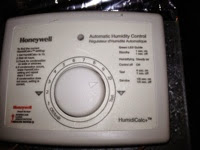
A day after changing the filter, I returned to make sure everything was OK. I discovered that no water was moving through the humidifier! I checked hose coming out of the valve to make sure it wasn't clogged and I found the valve was not allowing water to flow through it.


The valve was not opening, so, I dug out the multimeter. The label on the valve said it was looking for 24vac (volts AC), so, I went looking for 24VAC throughout the electrical flow.


I also checked the transformer that feeds electricity from the main power to the controller. I found 24 voltz everywhere I tested.
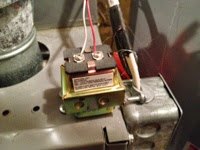


The valve was getting 24 volts, but wasn't working. So, the problem must be the valve! But new valves were around $100! And if I paid to have someone install it for me? I would be several hundred dollars into the repair. The answer was DIY! I started by finding the saddle valve. The Saddle valve is where the humidifier's water pipe pierced the main water pipe in order to get a water supply. In my case, the saddle valve pierced the hot water pipe coming out of the hot water tank. That makes sense to me: I would want to spray hot water into my furnace, not cold water, because hot water would evaporate faster and wouldn't try to cool down the air flow. In theory, if you turn the saddle valve clockwise, it is supposed to shut off the water flow to the humidifier. Instead, when I turned clockwise the saddle valve started leaking and spraying water.


I couldn't shut off the water supply so I came up with another plan. First, I disconnected the water supply from the valve.


Next, I disconnected the drain hose from the bottom of the humidifier and I stuck the water pipe into the drain hose.

With the water disconnected, I was able to remove the valve. I made sure the control knob was in the OFF position before removing the wire nuts and disconnecting the valve electrically, and then I unscrewed the valve from the base of the humidifier.


With the valve removed, the next step was to disassemble it. The way these solenoid  valve (Kip U147112) is that a magnet manipulates a plunger. When the magnet is engaged, the plunger raises allowing water to flow. Then the magnet is not engaged, a spring pushes the plunger down to block the water flow. Sometimes those plungers can get stuck either open or closed. Or sometimes the plunger will leak, but that wasn't my problem. No water was passing through the valve.


I disassembled the valve but could not get the plunger off the solenoid. So, I cleaned everything I could access the best that I could and reassembled it.


I put everything back together with low expectations that I made any difference. But to my surprise? Water started flowing into the filter!
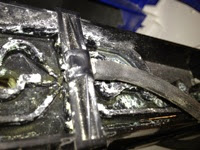


Apparently I was successful in getting the valve to open, but it wouldn't close now! So much water was coming through that it was overflowing into a bucket I had left out just in case. If the valve doesn't close, I would be supplying a nonstop flow of hot water all year long.


I immediately suspected I knew why the valve wasn't closing. I thought I didn't get the nut on the top of the valve tight enough, so, I tightened it up. That fixed it! The valve was now able to open and close.
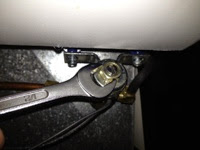


However, my work still wasn't done.When the valve was open, the humidifier was overflowing and pouring water into my catch bucket. I traced the drain hose and found a sediment clog that was restricting the flow of water.
With the clog cleared, the water drained successfully. The humidifier is now working and I saved several hundred dollars in repairs!


Friday, November 7, 2014

Winterizing the AC

Every fall my todo list turns toward winterizing the house. We don't need the air conditioner in the winter, so, it needs some attention.
First, we need to kill the power. There is an electrical box located behind the AC unit. I open that and flip the breaker. Done.

Next, I cover the Air Conditioner to protect it from the harsh New York winter. I use a plastic air conditioner cover that I additionally wrap with bungle cords to keep from blowing off.

With this yearly exercise complete, I can be  assured my air conditioner will be in relatively good condition next summer.

Thursday, August 7, 2014

Dehumidifier

I returned from vacation to find my basement at 70% humidity and smelling very musty. I suspected that if the humidity level raised much higher it might start raining in my basement!

My basement is always humid. There is a spring on the hill out back that feeds my sump pump all year long and keeps the basement moist. Usually I combat this with two 70 pint dehumidifiers, but one of them died last year. I had hopes to be able to survive on only one, but no luck
So I am now the owner of another 70 pint dehumidifier. These things are rather expensive, but are cheap when considering the  cost of damage that humidity can cause to a finished basement.

Wednesday, January 1, 2014

Furnace Filters

The joy of home ownership! And all the work. Changing furnace filters is a necessary yet fairly minor task.
I use the 3 month filters that cost $10-$15. I find the filters don't usually last 3 months before I start to see build-up, so, I often change them early. I make sure to change the filter when switching from air conditioning to heat and vice versa, and in between.

Another furnace related task is a yearly cleaning. You can save money by DiY - remove the side panels and vacuum out with a shop vac. By cleaning it myself I have the furnace professionally checked only every three years instead of the recommended yearly check.